Designing the Next Generation of Space Stations: Lessons from Offshore Oil and Gas Platforms
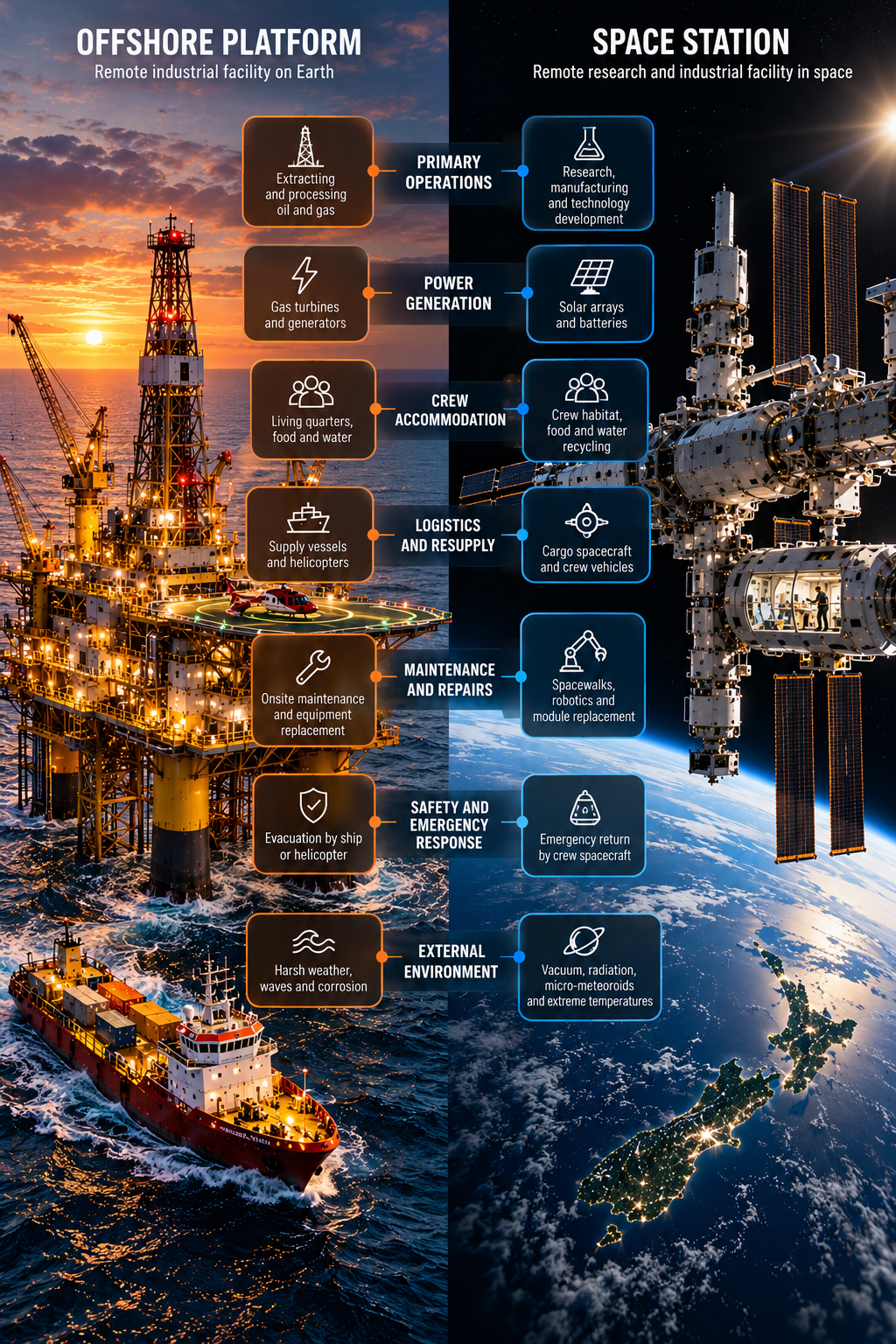
1. Understanding the Two Functions of a Space Station
An offshore production platform exists primarily to extract and process oil or gas. Its equipment, operating procedures and personnel are organised around these objectives.
However, the platform cannot operate without electricity, communications, maintenance, transportation, emergency systems and facilities to support the people working there.
These supporting functions are not secondary conveniences. They are essential capabilities without which the platform cannot conduct its primary mission.
A space station can be considered in much the same way.
Mission Operations
These are the activities the station has been established to undertake. Depending on its purpose, they may include:
Scientific research and experimentation.
Commercial manufacturing in microgravity.
Earth observation and technology development.
Human spaceflight research and training.
Spacecraft servicing and assembly.
Support for future lunar or deep-space missions.
Each activity requires specialist equipment, personnel, workspaces and operating procedures.
Station Sustainment Operations
These are the capabilities that allow the station and its personnel to continue functioning.
They include:
Power generation and distribution.
Life support and environmental control.
Food, water and consumables.
Communications and onboard computing.
Orbital maintenance and collision avoidance.
Crew accommodation and medical support.
Logistics, resupply and inventory management.
Equipment maintenance and repairs.
Emergency response and evacuation.
Both functions are essential, but they have different priorities.
Mission operations determine the station's purpose and intended output. Sustainment operations determine whether the station can continue delivering that output safely and reliably.
This distinction should influence every stage of space station design, from the arrangement of modules to the allocation of electrical power and crew responsibilities.
Space stations are among humanity's most complex engineering achievements. Operating hundreds of kilometres above Earth, these facilities combine scientific laboratories, industrial workplaces and human accommodation within an environment where virtually every aspect of daily life depends on engineered systems.
However, designing a successful space station involves much more than developing the technology required to reach orbit or constructing a facility capable of supporting astronauts.
It requires understanding how that facility will operate, how its primary activities will be supported, and how the station and its personnel will be sustained over many years.
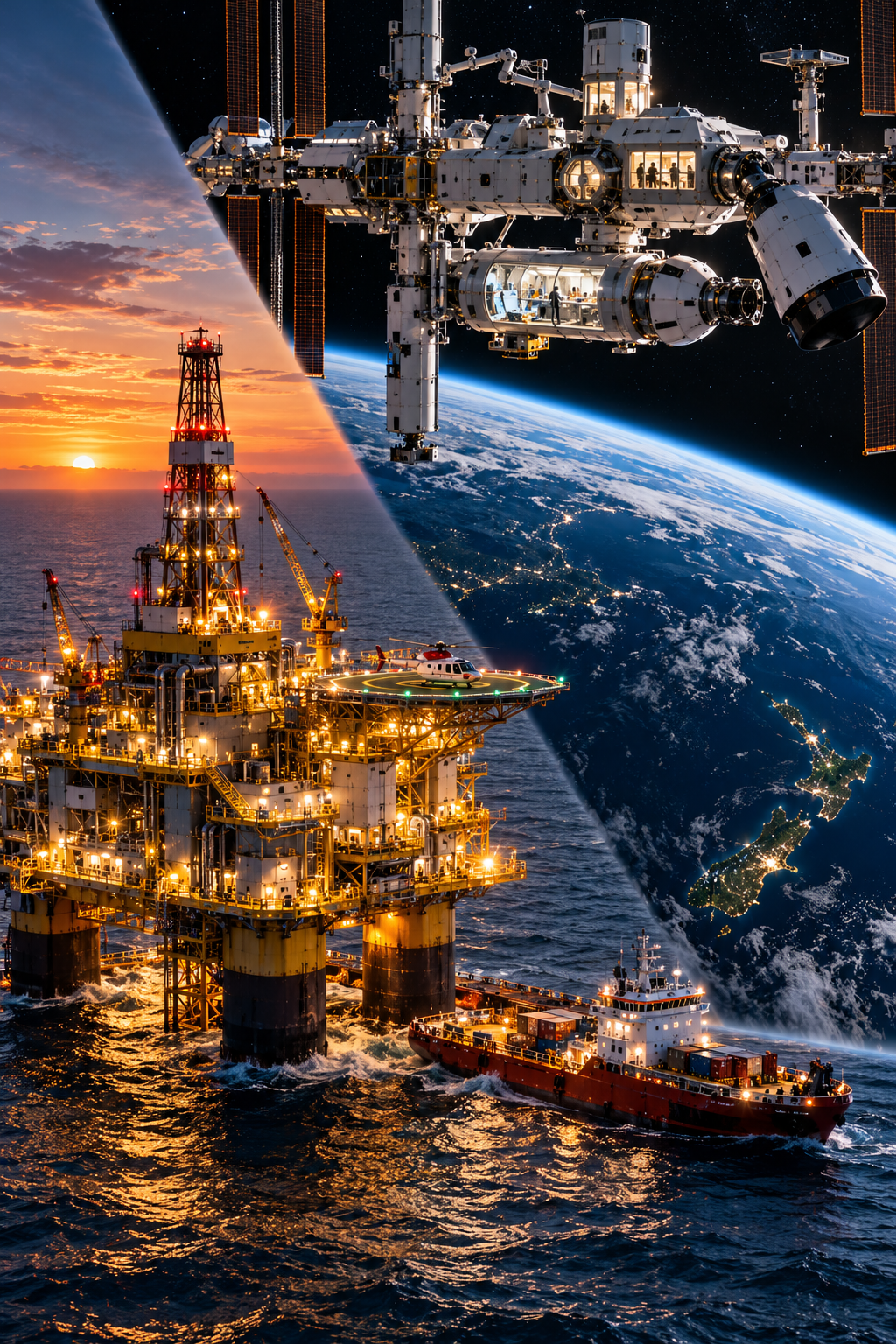
While space stations present unique engineering challenges, similar operational problems have already been addressed in other industries. One particularly relevant example is the offshore oil and gas sector.
Offshore drilling rigs and production platforms operate as remote industrial facilities, often far from established infrastructure and immediate assistance. They must conduct complex technical operations while simultaneously providing the power, accommodation, logistics, maintenance and emergency services necessary to sustain those operations.
These facilities effectively have two interconnected functions: conducting the activities for which they were established and sustaining the infrastructure and personnel required to undertake those activities.
A space station faces the same fundamental challenge.
As humanity moves towards commercially operated stations and more ambitious orbital infrastructure, lessons from offshore operations could help shape how future facilities are designed, managed and sustained.
2. Defining the Mission and Operational Requirements
Before designing a space station, operators must establish what activities it will support and the performance required to undertake them.
For offshore installations, drilling or production requirements influence the selection and arrangement of equipment, the size of the facility and the resources needed to sustain operations.
Similarly, the design of a space station must begin with a clear understanding of its intended mission.
A research station may require laboratories with specialised atmospheric controls, refrigeration, experiment storage and reliable data connections.
A commercial manufacturing facility may need greater electrical power, vibration isolation, robotics and the ability to transport finished products back to Earth.
A station supporting spacecraft servicing may require additional docking ports, external structures, robotic systems and storage for replacement components.
These different missions create different demands on the station's supporting infrastructure.
Choosing an Orbit
The station's orbital location is another fundamental decision.
Low Earth orbit provides relatively short communication delays and access through established launch systems. However, stations in these orbits experience atmospheric drag and must periodically adjust their altitude.
Orbital inclination influences accessibility from launch sites and determines which regions of Earth the station passes over.
Stations farther from Earth face different transportation, radiation, communications and emergency-response challenges.
Just as an offshore installation's location influences the vessels, helicopters and infrastructure needed to support it, a space station's orbit influences the spacecraft and logistics systems required to sustain its operations.
3. Designing the Station as a Working Facility
Offshore platforms are designed around the equipment and processes necessary to undertake their primary activities.
Drilling areas, production equipment, control rooms, machinery spaces and accommodation facilities are arranged to support efficient operations while managing safety risks.
A space station requires similar consideration.
Functional Work Areas
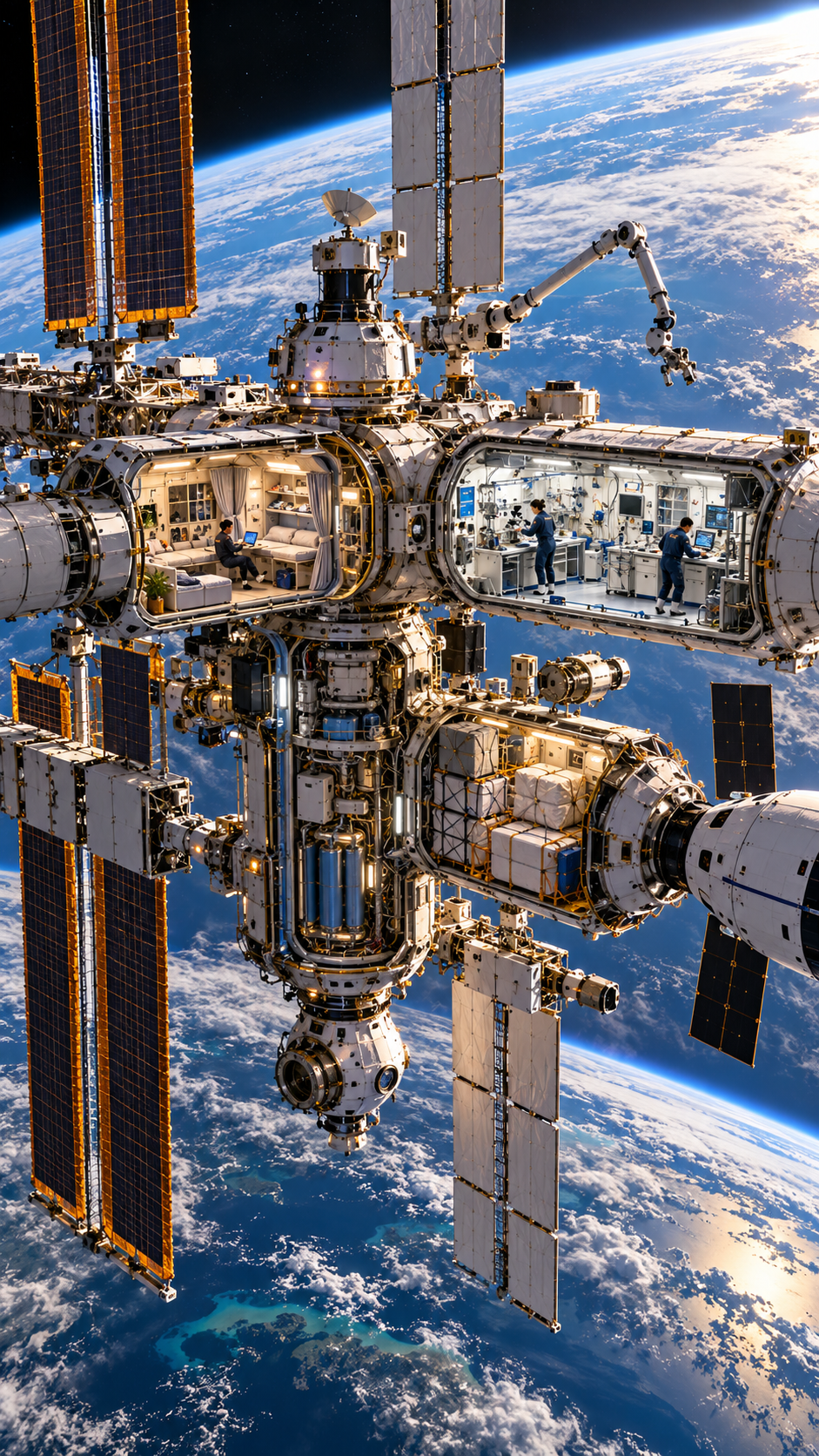
Laboratories, manufacturing facilities and operational workspaces must be designed around the activities conducted within them.
Equipment needs adequate space for installation, operation, inspection and maintenance.
In microgravity, additional consideration must be given to securing equipment and controlling the movement of loose objects, liquids and materials.
Modular Construction
The International Space Station (ISS) demonstrates the advantages of modular construction.
Individual modules can be launched separately, assembled in orbit and integrated into a larger facility.
Future stations may use similar approaches, potentially allowing operators to expand or replace facilities as mission requirements change.
However, adding modules is not simply a structural exercise.
Each additional module may increase demand for power, cooling, communications, environmental control and maintenance.
Modular expansion must therefore be supported by corresponding increases in sustainment capability.
Separating Activities and Hazards
Offshore installations often separate hazardous industrial processes from accommodation and essential control facilities.
A similar principle could influence future space station layouts.
Manufacturing activities involving unusual atmospheres, hazardous materials or significant mechanical forces may benefit from separation from crew accommodation and critical life-support systems.
The objective is to ensure that a problem in one functional area does not unnecessarily compromise the entire station.
4. Power Generation and Thermal Management
Electricity is fundamental to both offshore installations and space stations.
Offshore platforms require power for production equipment, pumps, compressors, communications, accommodation and safety systems.
Space stations similarly depend on electrical power for scientific equipment, computers, ventilation, environmental controls and other essential functions.
Power Generation
Most current space stations use solar arrays to generate electricity.
These arrays must be sufficiently large to support the station's anticipated electrical demand while remaining within structural and launch constraints.
Energy storage systems provide electricity when the station passes into Earth's shadow.
Managing Competing Requirements
An important design consideration is how available power will be distributed between mission equipment and essential station services.
For example, a commercial manufacturing facility may require considerable electricity for industrial processes.
However, those requirements must not compromise the power needed for life support, thermal control or communications.
Critical systems should receive priority during periods of reduced power availability.
This is a familiar problem in offshore operations, where essential safety and support systems must remain available even when production activities are interrupted.
Thermal Management
Almost every electrical system also generates heat.
In space, excess heat cannot be removed through normal atmospheric convection to the surrounding environment. Instead, stations use specialised cooling systems and external radiators.
Increasing a station's electrical capacity may therefore require additional cooling infrastructure.
Power generation and thermal management must be designed as interconnected systems rather than independent capabilities.
5. Life Support: Sustaining the People
One of the clearest parallels between offshore platforms and space stations is the need to support people living and working away from ordinary infrastructure.
Offshore personnel require accommodation, meals, drinking water, sanitation, ventilation, medical facilities and opportunities for rest and recreation.
Space station crews have similar human requirements, but must meet them within a completely artificial environment.
Atmospheric Management
Space stations must generate or supply oxygen, remove carbon dioxide and maintain appropriate atmospheric pressure.
Onboard ventilation is also essential because gases do not circulate naturally in microgravity in the same way they do on Earth.
Water Management
The cost of transporting water to orbit makes recycling particularly valuable.
The ISS has demonstrated advanced systems capable of recovering water from urine, atmospheric moisture and other wastewater sources.
NASA has demonstrated an overall water recovery capability approaching 98% using specialised processing equipment.
However, recycling efficiency does not eliminate the need for replacement components, maintenance or occasional replenishment.
Food and Consumables
Food remains a significant logistics requirement.
Long-duration crews need adequate nutritional supplies, suitable food storage and reliable preparation facilities.
Future stations may incorporate agricultural systems, but growing food at a scale sufficient to replace regular resupply presents substantial challenges.
Habitability
Crew accommodation must provide privacy, sleeping facilities, hygiene arrangements and space for recreation.
Exercise equipment is particularly important because microgravity affects muscle strength, bone density and cardiovascular health.
The offshore industry has long recognised that personnel living remotely require more than basic survival facilities.
Their physical and psychological wellbeing directly influences performance, safety and operational effectiveness.
The same principle applies to space station crews.
6. Logistics and Resupply: The Orbital Supply Chain
Offshore installations depend on established logistics networks to transport personnel, food, fuel, replacement equipment and other supplies.
Support vessels transport bulk cargo, while helicopters provide personnel transportation and support time-sensitive movements.
These operations require coordination between offshore facilities, transport providers, warehouses and onshore support organisations.
A space station requires a comparable logistics network, although cargo is transported using spacecraft rather than ships and helicopters.
Cargo Transportation
Space stations require regular deliveries of food, consumables, research equipment, replacement components and other materials.
The design must provide suitable docking or berthing arrangements, cargo-transfer capabilities and internal storage.
Some cargo may require temperature control, specialised handling or protection from contamination.
Crew Transportation
Crew rotation is another important logistics activity.
Transport spacecraft must deliver personnel safely, remain compatible with station systems and support emergency-return requirements where applicable.
Inventory Management
The remote nature of space stations makes inventory planning especially important.
A missing component cannot simply be purchased locally and delivered the following day.
Critical equipment may require spare parts to be pre-positioned onboard, particularly where failure could affect life support, power or station safety.
This creates a balance between carrying sufficient inventory and minimising the mass and volume that must be launched.
Reverse Logistics
Offshore facilities must also manage cargo returning to shore, including waste, damaged equipment and materials requiring specialist processing.
Space stations face similar requirements.
Scientific samples, completed experiments and certain components may need to return to Earth.
Other materials must be stored until they can be safely disposed of, including through approved cargo spacecraft disposal operations.
Logistics planning should therefore address both incoming and outgoing cargo.
The central lesson from offshore operations is that transportation is only one part of logistics. Storage, inventory management, distribution, scheduling and waste handling are equally important.
7. Maintenance and Asset Management
An offshore platform is expected to operate for many years, often in an environment that accelerates wear, corrosion and mechanical degradation.
Its continued operation depends on inspections, preventative maintenance, equipment replacement and periodic upgrades.
Space stations face comparable asset-management challenges.
Their equipment is exposed to vacuum, radiation, thermal cycling and potential impacts from small orbital debris.
Mechanical components, electronics, environmental systems and other equipment will require regular servicing throughout the station's life.
Designing for Maintenance
Equipment should be accessible for inspection and repair.
Modular components can allow crews to replace faulty assemblies without dismantling large sections of the station.
Adequate maintenance access should be considered during design rather than added after construction.
Predictive Maintenance
Sensors and diagnostic software may help identify changes in equipment performance before failures occur.
This could reduce unexpected downtime and allow replacement components to be included in planned resupply missions.
Robotic Maintenance
External maintenance presents additional challenges.
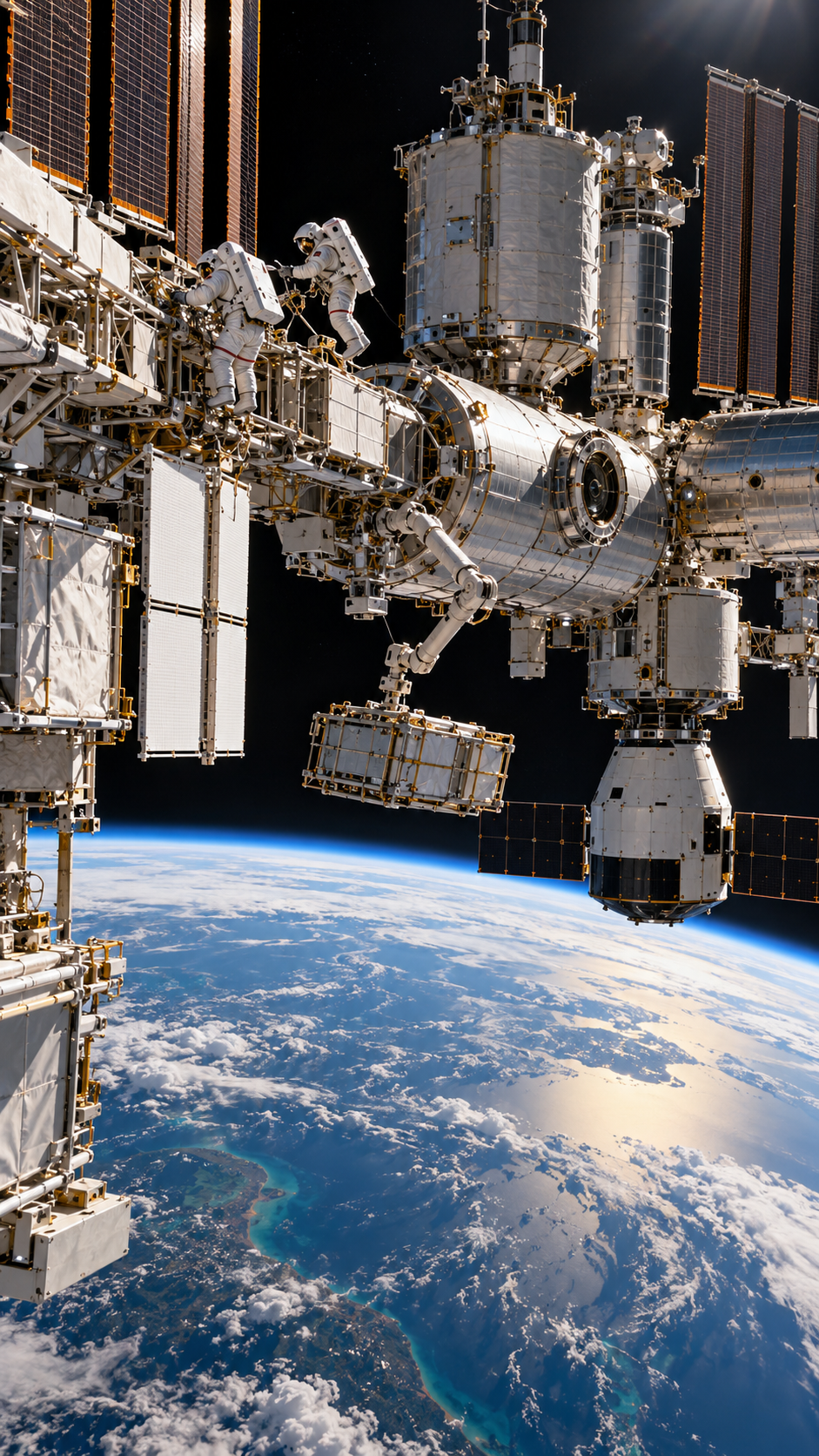
Spacewalks require extensive preparation and expose personnel to significant hazards.
Robotic systems may increasingly undertake inspections, equipment handling and selected servicing tasks.
Managing Operational Availability
A significant consideration is how maintenance affects the station's primary mission.
Just as maintenance on an offshore platform can reduce or temporarily halt production, space station maintenance may interrupt experiments or manufacturing activities.
Operators must therefore plan maintenance around mission priorities while ensuring essential safety requirements are not compromised.
The station's maintenance programme should be treated as part of its operational capability, not simply a response to equipment failures.
8. Orbital Operations and Space Domain Awareness
One major difference between offshore installations and space stations is the need to continuously manage orbital conditions.
Even when a space station is functioning normally, it must maintain its orbital trajectory and orientation.
Orbit Maintenance
Stations in low Earth orbit experience atmospheric drag, which gradually reduces their altitude.
Periodic manoeuvres are required to maintain the desired orbit.
These activities consume propellant and must be coordinated with visiting spacecraft and other operational requirements.
Attitude Control
A station must maintain a suitable orientation to support solar power generation, communications and thermal control.
Attitude-control systems use equipment such as control moment gyroscopes and propulsion systems to manage the station's orientation.
Space Domain Awareness
Space Domain Awareness (SDA) is essential for understanding the orbital environment surrounding the station.
Radar, optical sensors and other tracking systems provide information about satellites, rocket bodies and debris.
Operators use this information to assess potential close approaches between objects.
If a predicted conjunction presents an unacceptable collision risk, the station may need to conduct a Debris Avoidance Manoeuvre.
The Offshore Parallel
Offshore facilities must manage hazards associated with nearby vessels, navigation, marine operations and environmental conditions.
Space stations face a comparable need to maintain awareness of surrounding traffic, although orbital dynamics create very different risks and response requirements.
For a space station, SDA is not simply an external service. It is an important input into operational planning, manoeuvre decisions and maintaining the safety of the facility.
9. Safety, Emergency Response and Operational Resilience
Offshore installations operate under comprehensive safety requirements because accidents can rapidly threaten personnel and infrastructure.
Fire, gas releases, structural failures and severe environmental conditions are among the hazards considered in their emergency arrangements.
Space stations face different hazards, but the requirement for comprehensive emergency management is equally important.
Fire and Atmospheric Contamination
Fire aboard a space station can quickly threaten crew safety.
Detection, suppression, atmospheric monitoring and procedures for isolating affected compartments are essential.
Depressurisation
Damage to a pressure vessel or other pressurised structure may result in atmospheric leakage.
Stations require the ability to identify affected areas and isolate sections where necessary.
Equipment Failures
Critical systems must have suitable redundancy and failure-management procedures.
A loss of electrical power, cooling or atmospheric control could affect multiple systems simultaneously.
Emergency Evacuation
Offshore facilities incorporate evacuation arrangements, survival equipment and procedures for protecting personnel during emergencies.
New Zealand's offshore petroleum safety requirements include provisions for temporary refuge, emergency plans and lifesaving equipment.
Space stations require an equivalent approach appropriate to the orbital environment.
Crew return spacecraft can provide an emergency means of leaving the station, while onboard procedures must allow crews to manage incidents until evacuation or recovery is possible.
The Limits of External Assistance
A major distinction is the availability of emergency support.
Offshore personnel may receive assistance from nearby vessels, helicopters or shore-based emergency services, subject to distance and operating conditions.
Space station crews must be capable of responding to immediate emergencies using onboard resources.
This makes crew training, redundancy, accessible emergency equipment and fault isolation essential elements of station design.

10. Operating the Station as an Integrated System
An offshore platform requires coordinated management of production, maintenance, logistics, personnel and safety.
These activities often compete for limited resources.
Equipment maintenance may require production to be reduced. Transport restrictions may delay personnel changes. A system failure may require operational priorities to be reassessed.
Space stations face similar management challenges.
Mission Operations Management
Mission operations personnel are responsible for coordinating the scientific, commercial or other activities that justify the station's existence.
They manage experiment schedules, payload requirements, customer activities and specialist equipment.
Station Operations Management
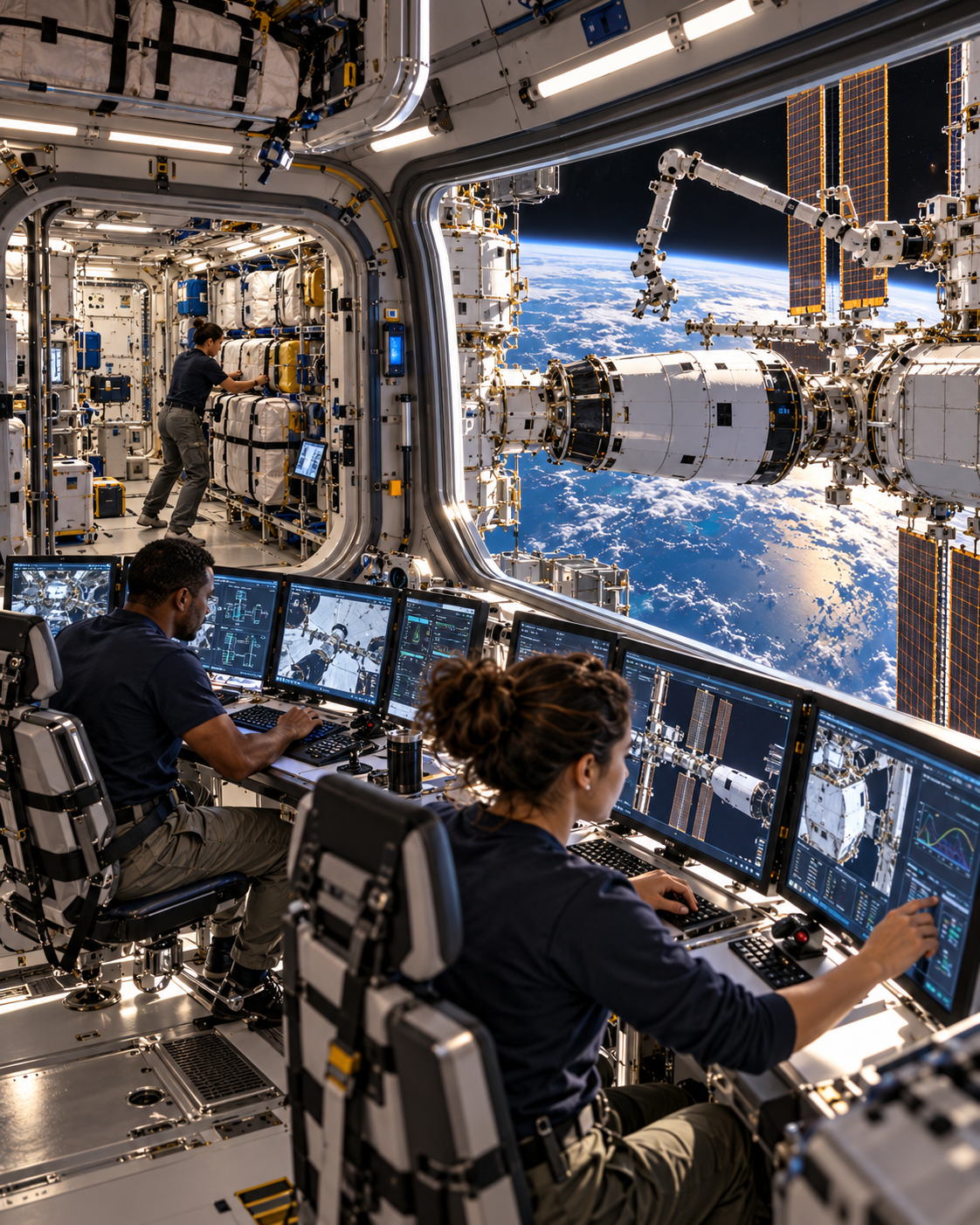
Station operations personnel are responsible for maintaining the facility's overall functionality.
This includes life support, electrical power, thermal management, communications, orbital operations, maintenance and safety.
Managing Competing Priorities
Consider a commercial manufacturing station with several customers conducting experiments simultaneously.
A cooling-system failure may require some industrial equipment to be shut down so that essential environmental-control systems can continue operating.
The decision cannot be made solely by considering the importance of the affected experiment.
Operators must consider crew safety, equipment protection, station stability and the consequences for other activities.
A clearly defined operational management structure will help ensure these decisions can be made quickly and consistently.
Integrated Planning
The station's operating schedule should incorporate both mission activities and sustainment requirements.
Cargo deliveries, crew rotations, maintenance tasks, orbital manoeuvres and scientific activities must be coordinated.
This is particularly important as commercial stations become more complex and accommodate multiple organisations.
A successful station must function as an integrated enterprise rather than a collection of independent systems.
11. Commercial Viability, Sustainability and Future Development
The offshore industry provides another useful lesson: the economic value of a facility depends on its ability to conduct productive operations throughout its lifetime.
Constructing an offshore platform is expensive, but its economic success ultimately depends on production performance, operating costs, maintenance requirements and the value of its output.
Future commercial space stations face a comparable challenge.
Revenue-Generating Activities
Potential sources of revenue include scientific research, manufacturing services, private astronaut missions and providing facilities to government agencies.
However, these activities must generate sufficient income to justify the investment required to build and operate the station.
Operating Costs
A station's ongoing expenses may include:
Crew and cargo transportation.
Ground-based mission control.
Maintenance and replacement components.
Communications and tracking services.
Insurance and compliance requirements.
Personnel training and operational support.
Station upgrades and eventual disposal.
Reducing these costs will be essential to establishing commercially sustainable orbital infrastructure.
Operational Efficiency
One of the most important performance measures may be the proportion of available station resources used for productive mission activities.
Electrical power, crew time, laboratory space and cargo capacity are all limited resources.
If excessive crew time is consumed by routine maintenance, less time remains for scientific and commercial work.
Similarly, equipment requiring frequent replacement increases logistics costs and reduces operational efficiency.
This creates a strong incentive to develop reliable, serviceable and increasingly autonomous systems.
International Collaboration
The ISS demonstrates how multiple nations can combine funding, technical expertise and operational capabilities.
Future facilities may employ different partnerships involving space agencies, commercial operators and research organisations.
Common technical standards and shared services could reduce costs and improve interoperability.
End-of-Life Planning
The eventual retirement of a station must also be considered during its initial design.
Large orbital structures may require controlled re-entry arrangements to reduce risks to people and property on Earth.
Disposal capability, remaining propellant, structural condition and other engineering considerations must therefore be managed throughout the station's operational life.
The Future of Space Station Operations
As the space industry develops, the design and operation of space stations may become increasingly specialised.
Commercial organisations are developing platforms intended to support research, manufacturing, private missions and other activities in low Earth orbit.
NASA is also working towards transitioning from direct operation of the ISS to purchasing services from commercially operated stations.
Projects involving Axiom Space, Starlab, Blue Origin's Orbital Reef and Vast demonstrate different approaches to future orbital infrastructure.
However, their success will depend on more than advanced technology or the ability to launch large structures into orbit.
They must establish viable operating models capable of delivering services reliably while managing complex infrastructure, logistics and safety requirements.
Automation and robotics may reduce crew workloads, while improvements in life-support systems and spacecraft transportation could lower operating costs.
Longer-term concepts, including rotating habitats and facilities beyond low Earth orbit, introduce additional challenges involving structural design, radiation protection, transportation and operational autonomy.
The lessons from offshore installations may become increasingly relevant as space stations transition from primarily government-operated research laboratories towards permanent commercial and industrial facilities.
Conclusion: From Engineering Achievement to Operational Capability
Space stations are often viewed primarily as engineering achievements.
Their construction demands advanced materials, propulsion systems, robotics, communications and life-support technologies.
However, constructing the facility is only the beginning.
The experience of the offshore oil and gas industry demonstrates that the long-term success of a remote installation depends on effectively managing two connected functions: conducting its primary mission and sustaining the infrastructure and personnel required to undertake that mission.
The same principle applies to space stations.
A sophisticated orbital laboratory has little practical value if it cannot be maintained, supplied or operated safely.
Likewise, a highly reliable station that cannot efficiently conduct its intended activities may struggle to justify its considerable cost.
Future space station design must therefore balance mission capability with operational endurance, ensuring that each supports the other.
This means considering maintenance access alongside laboratory layouts, resupply requirements alongside crew capacity, and emergency procedures alongside commercial activities.
As humanity expands its presence in orbit, the challenge will increasingly shift from simply building facilities in space towards operating them as dependable, productive and sustainable infrastructure.
Building a space station demonstrates what engineering can achieve. Sustaining its operations demonstrates whether we have developed the capability to live and work in space over the long term.