Considerations When Designing a Logistics System to Support a Moon Base
Establishing a permanent human presence on the Moon represents one of the most ambitious challenges in modern space exploration. While much attention is directed towards rockets, spacecraft and lunar habitats, an equally important challenge is developing the logistics systems necessary to sustain operations hundreds of thousands of kilometres from Earth.
A successful lunar settlement will require a continuous supply of food, water, equipment, spare parts and other essential resources. It must also maintain reliable transportation, communications, infrastructure and support services in an environment where resupply is expensive and emergency assistance cannot be provided quickly.
Although operating on the Moon presents unique challenges, humanity already has considerable experience supporting isolated facilities in extreme environments. One of the most relevant examples is Antarctica.
New Zealand's Scott Base and the United States' McMurdo Station demonstrate how complex logistics networks can sustain remote communities, scientific research and infrastructure in some of Earth's most hostile conditions.
Their operations provide valuable lessons for future lunar settlements, particularly in supply planning, transportation, inventory management, maintenance and international cooperation.
This article examines eleven considerations in designing a lunar logistics system, drawing parallels with Antarctic operations and exploring how established logistics principles could be adapted to support humanity's long-term presence on the Moon.
1. Understanding Lunar Conditions
The Moon presents an unforgiving operating environment, with extreme temperatures, abrasive dust, radiation exposure and challenging terrain.
Surface temperatures near the lunar equator can range from approximately −173°C during the lunar night to 127°C during the day. The absence of a substantial atmosphere also means equipment must operate in a near-vacuum environment.
Lunar regolith, the fine material covering the surface, introduces another challenge. Its abrasive particles can damage seals, mechanical components and sensitive equipment, making contamination control an important consideration for logistics operations.
The Moon's gravity is approximately one-sixth that of Earth. Although this reduces the weight of equipment, its mass and inertia remain unchanged. Cargo-handling machinery and transport vehicles must therefore be designed to manage heavy loads without losing stability or traction.
The Antarctic Parallel
Scott Base and McMurdo Station face comparable challenges in maintaining infrastructure under extreme environmental conditions.
Antarctic operations require specialised vehicles, equipment protection, heating systems and maintenance procedures. Equipment failures can have significant consequences, particularly during winter when access to external support is limited.
The lesson for lunar logistics is that environmental protection cannot be treated as an additional feature. It must be incorporated into equipment design, packaging, storage and handling from the outset.
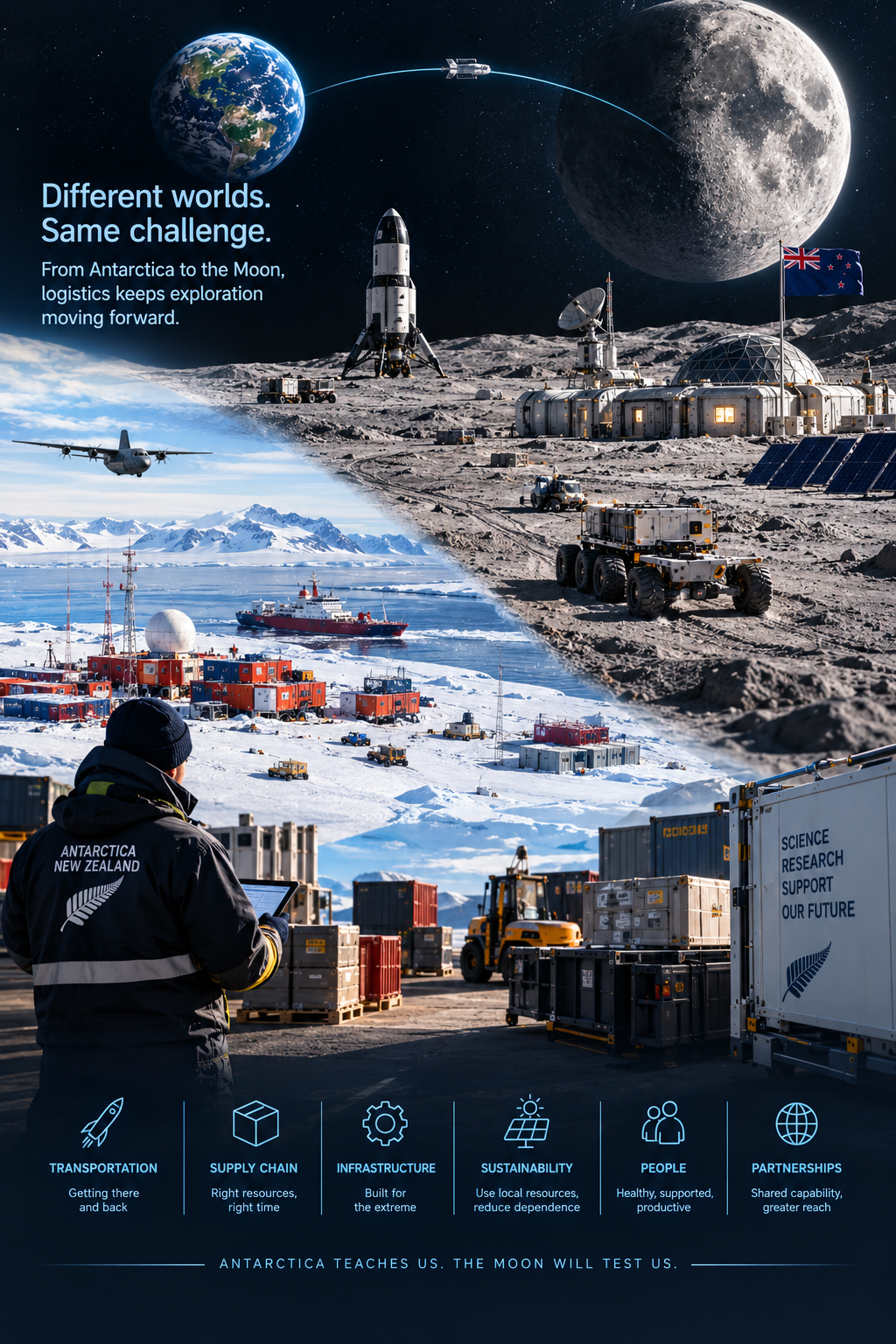
2. Transporting Supplies from Earth to the Moon
Transporting cargo to the lunar surface will require a coordinated network involving multiple vehicles, orbital operations and surface infrastructure.
Unlike transporting supplies between locations on Earth, delivering cargo to the Moon involves several distinct stages.
Launch Vehicles
Heavy-lift and commercial launch systems will play an essential role in transporting equipment and supplies from Earth.
Vehicles such as NASA's Space Launch System, SpaceX's Starship and Blue Origin's New Glenn represent different approaches to providing launch capability, although their specific roles in lunar logistics depend on mission architecture and further development.
Payload capacity, launch reliability, flight frequency and transportation costs will determine how effectively supplies can reach the lunar transportation network.
Orbital Transfer and Lunar Landing
Cargo may require additional propulsion stages or spacecraft to travel from Earth orbit to lunar orbit before descending to the surface.
Precision landing systems will be necessary to deliver equipment safely to designated logistics areas, potentially supporting autonomous unloading and distribution.
The relevant cost is not simply the price of launching a kilogram into Earth orbit, but the total cost of delivering usable cargo to its intended destination on the Moon.
The Antarctic Parallel
Scott Base and McMurdo Station provide an excellent example of integrated transport operations.
Their logistics systems combine maritime transport, strategic airlift, specialised aircraft and surface vehicles. Christchurch serves as a major Antarctic gateway, supporting the movement of personnel and cargo to the Ross Sea region.
During the Antarctic summer, cargo vessels deliver bulk supplies that would be considerably more expensive to transport by aircraft. Air transport provides greater flexibility for personnel movements, urgent equipment and time-sensitive supplies.
However, Antarctic logistics are highly dependent on seasonal conditions.
Antarctica New Zealand reports that regular flights to the Ross Island region generally operate between October and early March, while annual ship resupply normally occurs in February.
During winter, flight opportunities become much more limited, requiring stations to maintain substantial stocks and operate with greater self-sufficiency.
A lunar settlement would face different constraints. Its transport schedules would depend on launch opportunities, orbital mechanics, spacecraft availability, landing capability and mission priorities rather than seasonal sea ice or Antarctic weather.
Nevertheless, the underlying principle is identical: resupply opportunities must be anticipated, prioritised and coordinated well before supplies are required.
For lunar operations, this suggests establishing scheduled cargo delivery campaigns, supported by contingency transport capacity for critical supplies where practical.
3. In-Situ Resource Utilisation (ISRU)
One of the greatest opportunities for reducing lunar logistics requirements is the potential to use resources already available on the Moon.
This approach is known as in-situ resource utilisation, or ISRU.
Potential applications include extracting water ice, processing lunar regolith into construction materials and producing oxygen or propellant components.
Water ice in permanently shadowed polar regions could eventually support drinking water, oxygen generation and fuel production, although extracting and processing these resources at an operational scale remains a significant technical challenge.
Similarly, lunar regolith could potentially be used to manufacture structural materials or provide radiation shielding for habitats and storage facilities.
These capabilities could reduce the volume of material transported from Earth, but they would require considerable infrastructure, energy and maintenance support.
The Antarctic Parallel
Antarctic stations illustrate the value of reducing external supply requirements.
Facilities must generate electricity, manage water, treat wastewater and maintain essential infrastructure locally.
The redesigned Scott Base is being planned around resilient infrastructure capable of supporting isolated operations with limited external assistance.
A Moon base would need to take this principle considerably further.
Rather than viewing local resource production as a separate scientific experiment, future planners should consider how it can become part of the logistics network, reducing demand for imported supplies while maintaining sufficient reserves if production systems fail.
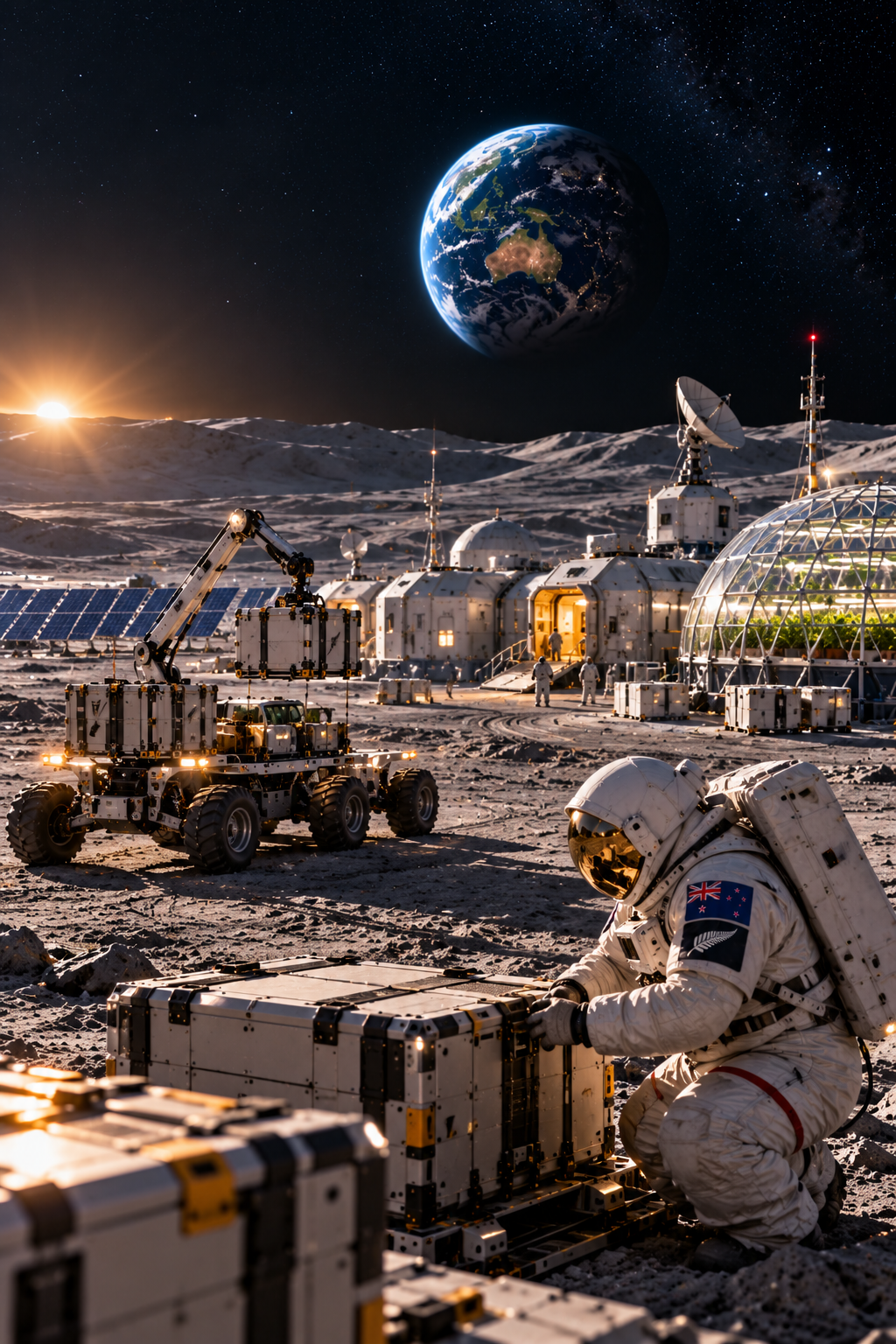
4. Transport Systems on the Lunar Surface
Once supplies reach the Moon, they must be transported from landing areas to storage facilities, habitats, research stations and construction sites.
Surface transportation will therefore become a critical component of lunar logistics.
Rovers and Cargo Vehicles
Lunar cargo vehicles will need to operate across uneven terrain while managing dust, extreme temperatures and reduced gravity.
Autonomous vehicles could transport supplies between designated locations, reducing the workload on astronauts and allowing movement during periods when crews are occupied with other tasks.
Fixed Distribution Infrastructure
As settlements expand, pipelines, conveyors or other automated systems could distribute resources such as water, oxygen and processed regolith between facilities.
This could reduce the need for repeated vehicle movements and associated equipment wear.
The Antarctic Parallel
McMurdo Station supports inland Antarctic operations through a combination of aircraft and overland traverses.
The South Pole Traverse, for example, allows fuel and other supplies to be transported overland rather than relying entirely on aircraft.
The lesson for lunar operations is that transportation should be matched to cargo characteristics.
Not every delivery requires the same vehicle or level of urgency. A mature lunar logistics network may similarly combine heavy cargo rovers, smaller autonomous vehicles and fixed distribution systems.
5. Power Systems
Reliable electricity will be essential for every aspect of lunar operations, including communications, habitation, cargo handling, transportation and resource processing.
Solar power is an attractive option, particularly near certain lunar polar locations where some elevated terrain receives extended periods of sunlight.
However, illumination is not continuous everywhere, and many lunar locations experience darkness lasting approximately two Earth weeks.
Energy storage and alternative power generation will therefore be essential.
Small nuclear fission power systems are being investigated as a potential means of providing dependable electricity independently of sunlight.
The Antarctic Parallel
Antarctic research stations must maintain reliable power and heating throughout extended periods of isolation.
An interruption can affect far more than lighting. It can compromise water treatment, communications, temperature control and scientific operations.
The same systems-level thinking is necessary on the Moon.
Logistics planners must ensure that energy generation, distribution and storage are treated as essential infrastructure, with redundancy and sufficient capacity to support critical operations during equipment failures.
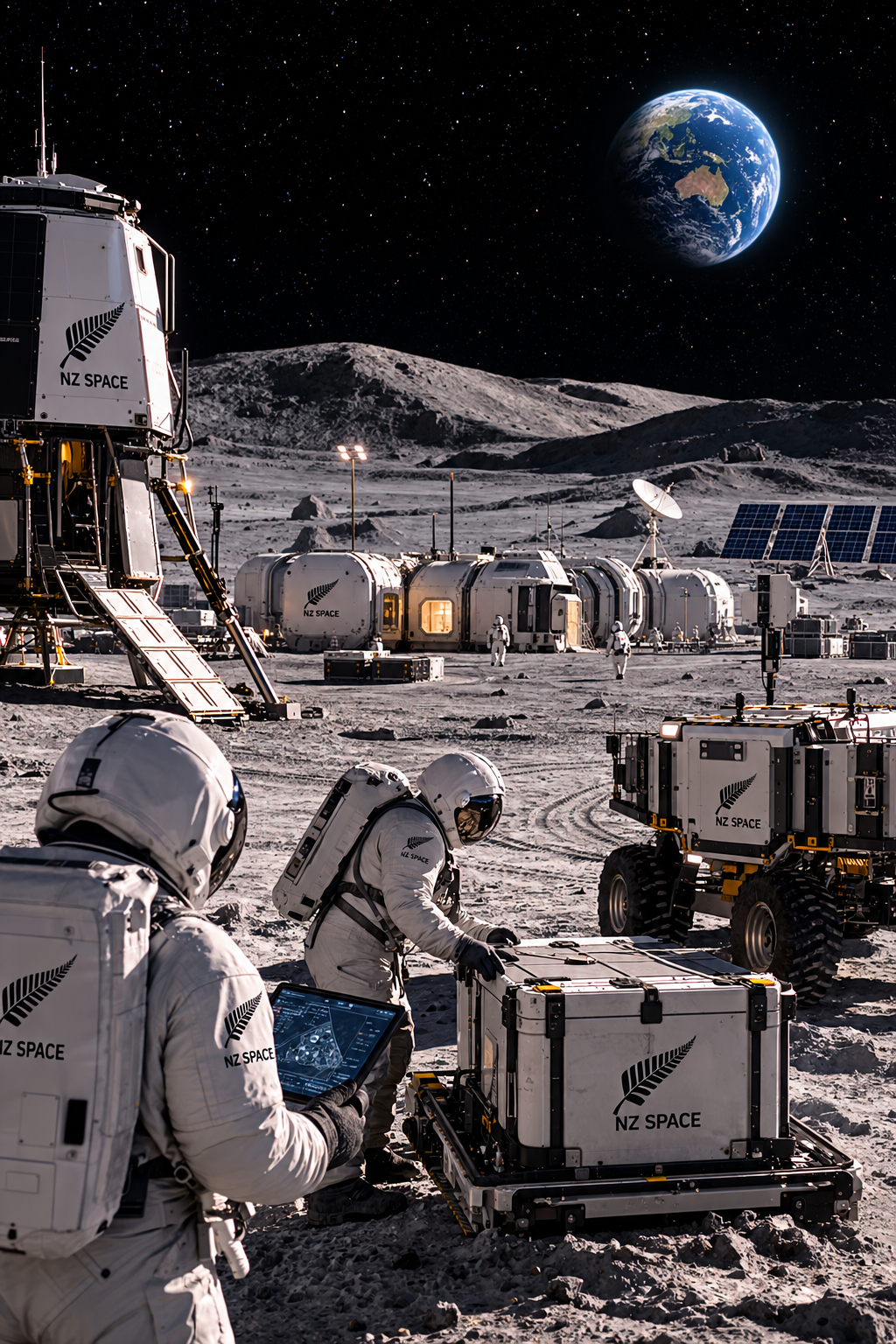
6. Communication Networks
A lunar logistics network requires reliable communications between Earth, spacecraft, surface vehicles and settlement infrastructure.
This includes coordinating cargo movements, monitoring inventories, tracking equipment and managing emergencies.
Communication systems may involve direct Earth links, lunar relay satellites and local networks connecting habitats, vehicles and logistics facilities.
A radio signal takes approximately 1.3 seconds to travel one way between Earth and the Moon, depending on their relative positions. This creates communication delays that must be considered when controlling equipment remotely.
Autonomous systems will therefore be particularly valuable for operations requiring immediate decisions.
The Antarctic Parallel
Scott Base and McMurdo Station rely on communication networks to coordinate flights, field operations, scientific activities and emergency responses.
Specialist New Zealand military personnel support communications and coordination functions, including maintaining contact with researchers operating away from Scott Base.
The lunar equivalent would require an integrated communications network with backup systems capable of maintaining essential services during outages.
7. Storage and Distribution
Transporting supplies to a Moon base is only one part of the logistics challenge.
Once delivered, resources must be stored, protected, tracked and distributed efficiently.
Storage facilities must account for temperature extremes, radiation exposure, vacuum conditions and the characteristics of individual materials.
Food, medical supplies, electronics, fuel and mechanical components will have different storage requirements.
Inventory Management
Accurate inventory management will be essential to maintaining operational capability.
A lunar settlement must know not only what equipment it possesses, but also where it is located, its serviceability, expected consumption and replacement lead time.
Particularly important items may require additional safety stocks to account for unexpected consumption, equipment failures or delayed resupply missions.
The Antarctic Parallel
Before Antarctic winter, Scott Base and McMurdo must ensure adequate supplies are available to sustain operations during periods when routine resupply becomes difficult.
This requires forecasting consumption, planning maintenance requirements and anticipating potential failures months in advance.
The same principle applies to lunar logistics, but with significantly greater consequences.
A missing component at Scott Base may be difficult to replace during winter. A missing component on the Moon could require an entirely new launch and landing mission.
Consequently, lunar inventory management should consider the operational consequences of an item becoming unavailable, rather than focusing solely on minimising stock levels.
Critical items such as life-support components, medical consumables and power-system spares may warrant multiple independent reserves.
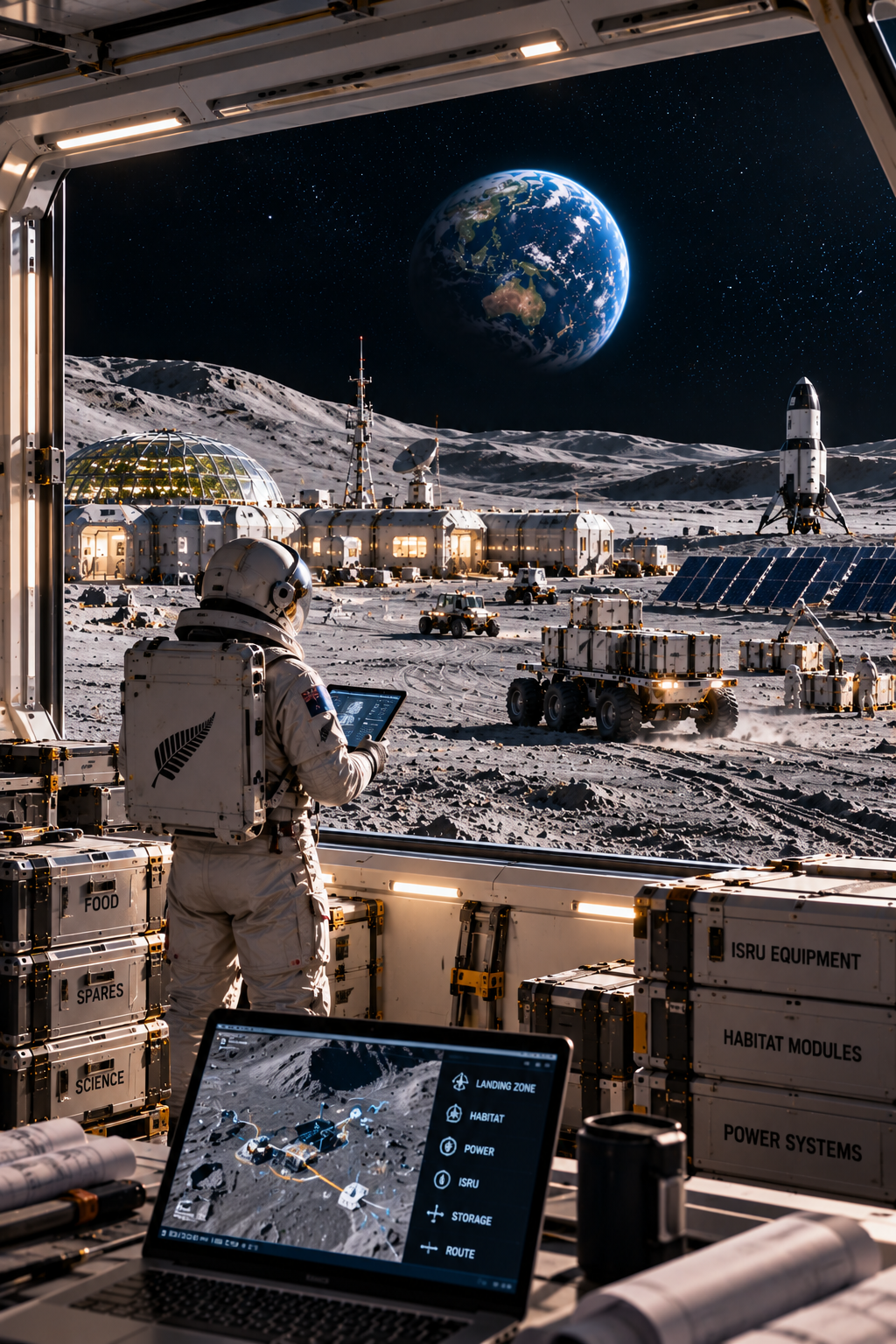
8. Maintenance and Repair Systems
Equipment operating on the Moon will experience mechanical wear, radiation exposure, temperature cycling and contamination from lunar dust.
Maintenance and repair capabilities must therefore be incorporated into the initial settlement design.
Spare Parts and Repair Facilities
Lunar workshops will require specialised tools, diagnostic equipment and replacement components.
Modular equipment designs could simplify maintenance by allowing defective assemblies to be replaced without extensive repairs.
Additive manufacturing, commonly known as 3D printing, may eventually allow certain components to be produced locally, reducing the need to transport every replacement item from Earth.
However, locally manufactured components would still require suitable materials, manufacturing equipment and quality assurance.
Preventative Maintenance
Sensors and automated monitoring systems could track equipment condition and identify developing faults before they cause operational failures.
The Antarctic Parallel
Maintenance planning is fundamental to Antarctic operations.
Engineering teams maintain buildings, generators, vehicles and other infrastructure throughout periods when spare parts and specialist assistance may be difficult to obtain.
New Zealand military personnel also contribute specialist trade and engineering support to Antarctic operations.
This demonstrates an important principle: logistics is not simply about delivering equipment. It is about maintaining that equipment throughout its operational life.
A Moon base must be designed around the ability to inspect, service and repair critical systems with the resources already available on-site.
9. Human Factors and Crew Support
Supporting personnel on the Moon will involve much more than delivering equipment and maintaining infrastructure.
Logistics systems must provide food, water, medical supplies, personal equipment and suitable living conditions.
Closed-loop life-support systems will help recycle water and other resources, reducing the quantity of consumables transported from Earth.
However, these systems will still require replacement components, maintenance and contingency supplies.
Crew wellbeing will also influence logistics planning.
Access to varied food, personal items, recreational equipment and communication with family can contribute to morale during extended periods of isolation.
The Antarctic Parallel
Personnel wintering at Scott Base or McMurdo experience prolonged isolation, restricted travel opportunities and demanding environmental conditions.
These experiences provide useful lessons for crew selection, training, recreational facilities and maintaining psychological wellbeing.
Although the Moon introduces additional hazards and much greater distance from Earth, many of the human challenges associated with isolated operations are familiar.
Logistics planning must therefore support both the physical requirements of survival and the human requirements of sustained performance.
10. Long-Term Sustainability
For a lunar settlement to develop beyond a temporary research outpost, its logistics system must become progressively more sustainable.
This will require improving resource efficiency, reducing waste and developing infrastructure capable of supporting a growing population.
Recycling and Waste Management
Recycling systems could recover water, process organic waste and reuse suitable materials.
Over time, local manufacturing and resource extraction may reduce dependence on Earth-based supplies.
However, waste management must remain an integral part of logistics planning.
The Antarctic Parallel
Antarctic logistics provide an important example of reverse logistics: transporting unwanted material away from an operating location.
During the 2025 McMurdo resupply operation, the cargo vessel MV Ocean Giant delivered 380 pieces of cargo before loading 360 containers of returning cargo, including waste, recyclable materials and equipment no longer required.
A lunar settlement would face different constraints because transporting waste back to Earth would be expensive.
This makes recycling, repair, reuse and safe local waste management even more important.
Scalability
Lunar logistics infrastructure should be modular, allowing additional storage, power, transportation and maintenance capability to be introduced as requirements increase.
Early systems may support small crews and short-duration missions. Later infrastructure could support larger settlements, industrial activities and more extensive scientific operations.
11. International Collaboration and Governance
Developing a sustainable lunar logistics network will require cooperation between governments, space agencies, commercial organisations and research institutions.
The significant costs of lunar transportation and infrastructure make shared capabilities particularly attractive.
Shared Infrastructure
Common landing facilities, communications networks, surface transportation systems and logistics hubs could reduce duplication and improve efficiency.
Interoperable equipment and standardised cargo interfaces may allow resources to be transferred between different vehicles and facilities.
Operational Coordination
Cooperative lunar operations will require agreed procedures for cargo priorities, emergency support, equipment compatibility and the use of shared infrastructure.
Legal and regulatory arrangements will also need to address responsibilities, resource activities and operational safety consistent with international space law.
The Antarctic Parallel
The relationship between Scott Base and McMurdo Station demonstrates how international cooperation can support complex operations in remote environments.
New Zealand and the United States have established arrangements for sharing Antarctic logistics resources, while the New Zealand military contributes personnel, aircraft and specialist capabilities.
Both national Antarctic programmes benefit from coordinated transport, infrastructure and operational support.
A similar approach could provide substantial benefits on the Moon.
Rather than individual nations and companies independently duplicating every logistics capability, future lunar operations could employ shared services while maintaining national or commercial responsibility for their respective activities.
The Antarctic experience illustrates that effective cooperation requires more than goodwill. It depends on clear agreements, common procedures, coordinated planning and established operational relationships.
Conclusion: From Exploration to Sustained Operations
Designing a logistics system to support a permanent Moon base is a challenge that extends well beyond the development of rockets and spacecraft.
Success will require an integrated network of transportation, storage, distribution, maintenance, communications and infrastructure capable of sustaining human activity in a remote and unforgiving environment.
The experiences of Scott Base and McMurdo Station demonstrate that operating isolated facilities is fundamentally a logistics problem.
Their continued operations depend on detailed planning, dependable transportation, carefully managed inventories, resilient infrastructure and cooperation between multiple organisations.
The Moon introduces additional challenges, including the cost of space transportation, the absence of a breathable atmosphere and the difficulty of providing emergency assistance.
However, many of the underlying logistics principles remain relevant.
By drawing on decades of Antarctic experience, future lunar planners can better understand the importance of supply-chain resilience, pre-positioned resources, preventative maintenance, operational flexibility and international cooperation.
As lunar exploration progresses, the focus must gradually shift from simply delivering missions to the Moon towards developing the infrastructure required to sustain them.
Getting to the Moon is a transportation challenge. Remaining there is a logistics challenge.
The nations and organisations that successfully address both will help shape the future of sustained human operations beyond Earth.